
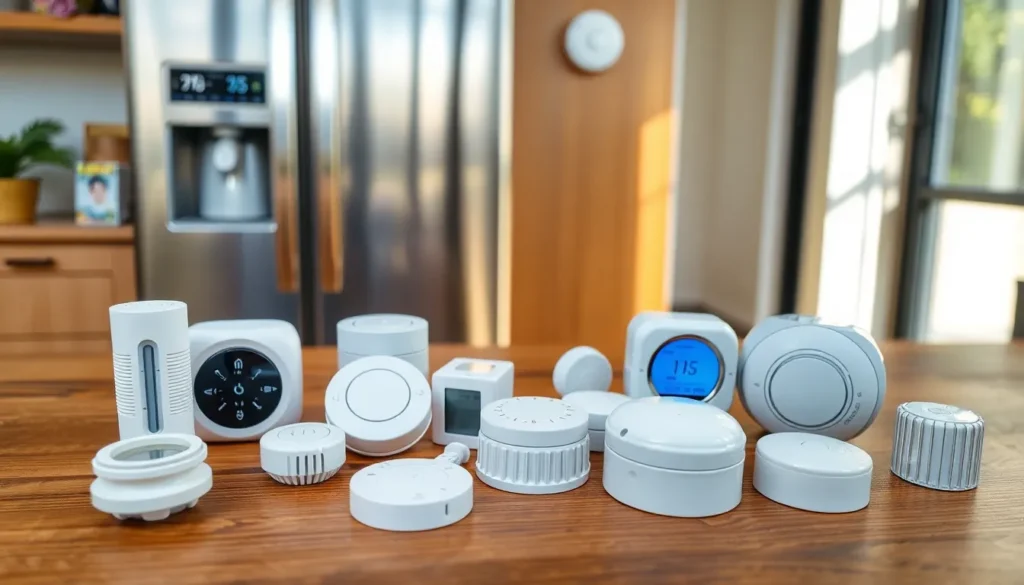
In a world where your fridge can remind you to buy milk and your thermostat knows when you’re too hot to handle, IoT sensors are the unsung heroes making it all happen. These tiny gadgets are like the secret agents of the tech world, collecting data and communicating with each other to create a smarter, more efficient environment. Who knew that a little sensor could have such a big impact?
Table of Contents
ToggleOverview of IoT Sensors
IoT sensors play a crucial role in modern technology. These devices monitor and collect data from the environment, enabling seamless communication between various systems. Temperature sensors adjust heating or cooling in smart buildings, improving energy efficiency. Motion detectors enhance security measures, providing real-time alerts on unauthorized access.
Smart fridges utilize humidity sensors to maintain optimal food preservation conditions. Pressure sensors often monitor machinery in industrial settings, predicting maintenance needs before failures occur. Light sensors adjust artificial lighting based on natural light availability, optimizing energy consumption.
Wireless technology allows these sensors to transmit data to central hubs or the cloud. This data enables users to track usage patterns and make informed decisions. In agricultural settings, soil moisture sensors help farmers efficiently manage irrigation, resulting in better crop yields.
Examples of IoT sensors include temperature sensors, acceleration sensors, and gas sensors. Each sensor type contributes uniquely to various applications, from automation in homes to advancements in healthcare. Healthcare wearables with heart rate sensors monitor vital signs, alerting users to potential health issues.
Deployment of these sensors supports data-driven insights that lead to greater efficiency and convenience. Integration with machine learning algorithms allows for predictive analytics, enhancing decision-making processes. Consequently, industries maximize productivity and minimize resource waste through these technologies.
Types of IoT Sensors
IoT sensors come in various types, each serving specific functions that enhance technology’s capabilities. Understanding these sensors facilitates smarter environments and improved data collection.
Environmental Sensors
Environmental sensors monitor conditions like temperature, humidity, and air quality. They play a key role in smart buildings by helping maintain optimal environments. For instance, temperature sensors adjust heating and cooling systems based on real-time data. Humidity sensors ensure ideal conditions for storing food in smart refrigerators. Air quality sensors detect pollutants, providing vital information for public health. Together, these sensors support automated systems aimed at energy efficiency and comfort.
Motion Sensors
Motion sensors detect movement within a designated area, enhancing security and automation. Passive infrared sensors sense heat from bodies, making them effective for intruder alerts. Ultrasonic sensors emit sound waves to identify proximity, commonly used in home automation systems. Another type is the microwave sensor, which utilizes electromagnetic waves for detection. These sensors not only improve safety but also contribute to energy savings by activating lights when movement is detected.
Optical Sensors
Optical sensors capture data through light and are essential for various applications. They convert light signals into electrical signals, enabling systems to interpret visual information. Camera-based sensors facilitate facial recognition and monitoring in security systems. In agriculture, optical sensors assess crop health by analyzing light reflection. These sensors enhance automation processes while providing valuable insights into different environments.
Applications of IoT Sensors
IoT sensors play a crucial role across various sectors, enabling innovative solutions and enhancing efficiency. Their applications range from smart homes to healthcare and industrial automation.
Smart Homes
Smart homes leverage IoT sensors for improved convenience and energy savings. Temperature sensors regulate heating and cooling systems, ensuring comfort while minimizing energy consumption. Motion detectors enhance security by providing real-time alerts when unexpected movement occurs. Smart appliances utilize humidity sensors to maintain optimal conditions for food preservation. By analyzing usage patterns, smart devices can automatically adjust settings, further optimizing energy efficiency and enhancing user experience.
Healthcare
In healthcare, IoT sensors monitor patients’ vital signs and health conditions in real-time. Wearable devices employ heart rate and blood pressure sensors to track critical health metrics. These sensors alert healthcare professionals immediately if any anomalies arise. Remote monitoring allows patients to receive timely care without repeatedly visiting clinics. Additionally, ambient light and temperature sensors contribute to creating comfortable environments for patients in hospitals. The integration of IoT sensors in healthcare drives proactive management of health issues and improves patient outcomes.
Industrial Automation
Industrial automation benefits significantly from IoT sensors, enabling predictive maintenance and operational efficiency. Vibration sensors monitor machinery performance, identifying potential faults before they escalate. Temperature and pressure sensors ensure optimal conditions in production processes, preventing costly downtimes. Inventory tracking through RFID sensors improves supply chain management by providing real-time data on stock levels. Data derived from these sensors informs decision-making, enhances productivity, and reduces waste in manufacturing environments.
Benefits of IoT Sensors
IoT sensors deliver numerous advantages that enhance both personal and industrial environments. These devices streamline processes, collect vital data, and ultimately promote smarter decision-making across various sectors.
Enhanced Efficiency
Enhanced efficiency is a hallmark of IoT sensor technology. Organizations utilizing these sensors experience improved resource management and reduced waste. For example, smart thermostats adjust heating and cooling based on occupancy data, lowering energy costs. Similarly, manufacturers employ sensors that monitor production processes, identifying areas for improvement and minimizing downtime. By automating routine tasks, these devices allow personnel to focus on more strategic activities. Consequently, companies achieve better overall productivity while maintaining high operational standards.
Real-Time Data Collection
Real-time data collection features prominently in IoT sensor benefits. Sensors transmit information instantly, ensuring users access up-to-date insights. Wearable health devices track heart rates and physical activity continuously, alerting users to significant changes. In agricultural settings, soil moisture sensors detect hydration levels and transmit data to irrigation systems, optimizing water usage. Businesses leverage this immediate access to data for informed decision-making, enhancing their responsiveness to market changes. Deploying IoT sensors ultimately supports proactive strategies, benefiting various industries by allowing nimble adaptations in operations.
Challenges and Considerations
IoT sensors, despite their benefits, face several challenges that organizations need to address. Strong knowledge of these challenges can guide successful implementation.
Security Risks
IoT sensors are vulnerable to cyberattacks due to their connectivity. Attackers might exploit weak encryption protocols, gaining access to sensitive data or compromising devices. A significant rise in IoT-related breaches underscores the urgency of implementing robust security measures. For instance, companies are advised to use secure authentication and regularly update firmware to protect networks. Intrusion detection systems also enhance security by monitoring unusual activity in real-time. Ensuring the integrity of these devices becomes crucial as organizations expand their IoT ecosystems.
Data Privacy
Data privacy concerns emerge prominently in discussions about IoT sensors. These devices collect vast amounts of personal and sensitive information, often without explicit consent from users. Specific regulations, such as GDPR, impose strict guidelines on data collection practices to safeguard users’ rights. Organizations must prioritize transparency by informing users about data usage and retaining only necessary information. Compliance with privacy regulations can also enhance customer trust, wearing down fears related to data misuse. Adopting strong encryption techniques further strengthens privacy protections, ensuring that data remains secure during transmission.
The impact of IoT sensors on modern life is undeniable. These devices not only enhance convenience but also drive efficiency across various sectors. By collecting and transmitting real-time data, they empower users to make informed decisions that optimize resource management and improve overall productivity.
While the benefits are substantial, it’s crucial to address the associated security and privacy challenges. Organizations must adopt robust measures to protect sensitive data and ensure compliance with regulations. As technology continues to evolve, the role of IoT sensors will likely expand, paving the way for smarter and more connected environments that enhance daily living and operational effectiveness.


